AT LAST

 I learned a lot from this program.  I’m going to introduce what I learned

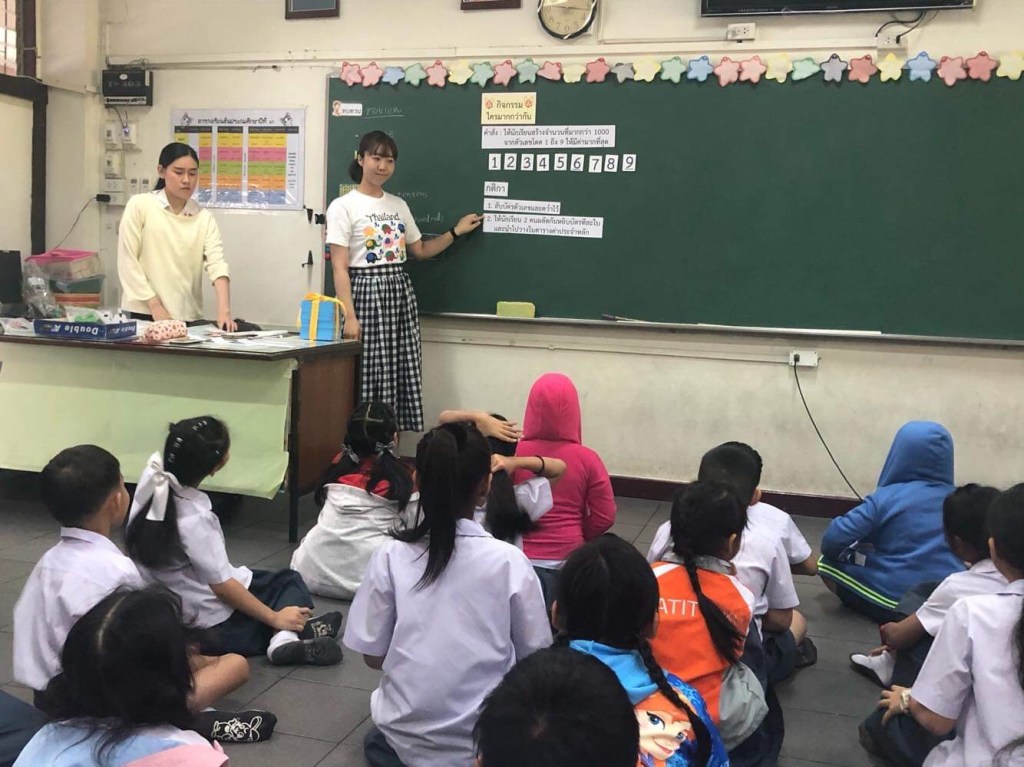
 I stayed as a trainee at Khon Kaen University Elementary School for one month.  I rented a desk in the staff room of the second grade teachers because I was in charge of arithmetic for the second grade of elementary school.  Aside from that, much of what I learned during school was about differences between elementary schools in Japan and the one of Thailand.  What surprised me the most was that the students sat on the floor instead of sitting on chairs when listening to math classes.  Of course, every student has their own desk, and sometimes they have to work on seats.  However, when they listen to their teacher, they usually sit on the floor.  When they sat on the floor, the physical distance between the students and the teacher was closer, so I felt that the quality of the lessons was good for both the students and the teacher.  Also, when they listen to the teacher, the students might be able to concentrate on answering the teacher’s questions and listening to explanations instead of taking notes, etc. so that understanding might possibly increase.

 Arithmetic classes usually take the following steps:

 Review → Input of new knowledge → Output by assignment → Summary

 I think this process is also well-used in Japanese mathematics education.

 The review mainly repeats the contents of the previous lesson.  At this time, I felt that the point was not to say everything by teacher but to draw knowledge from the students.

 The input of new knowledge is mainly to help students learn the process while solving textbook examples.

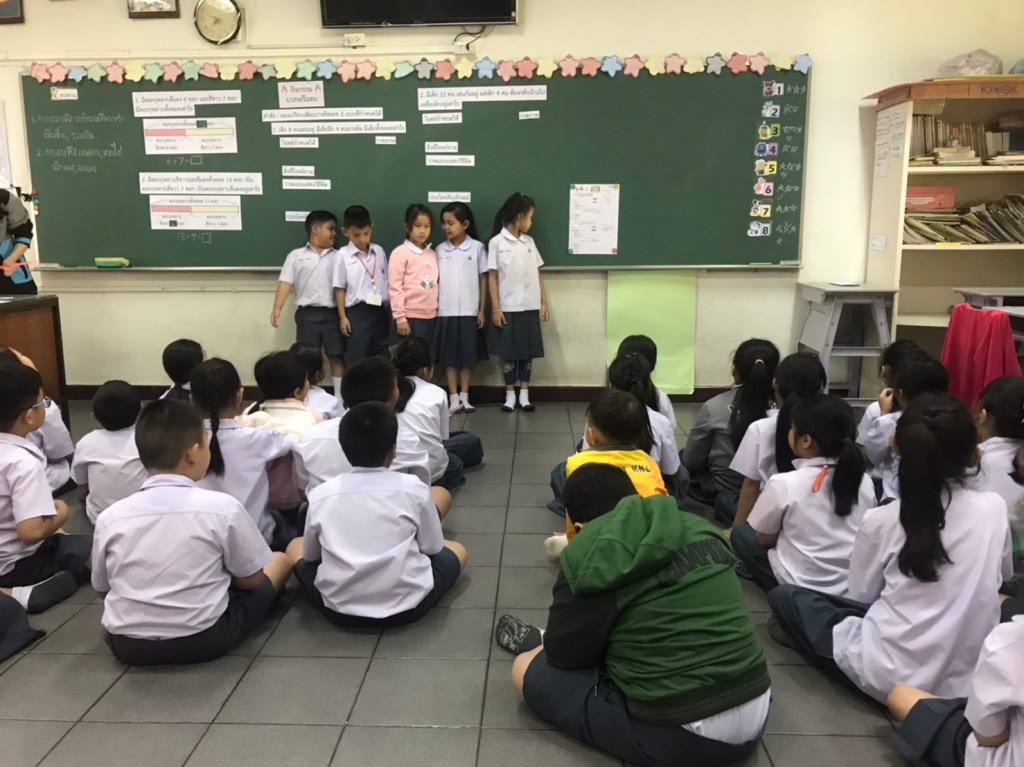
 Assignment output allows students to gain knowledge by distributing prints and solving problems, as well as for teacher, to confirm students’ understanding.  Often, five or six students complete a single print.  Group work.  Students are required to write not only the answer to the question on the print, but also the reason for thinking so.  They share the work among the members of the group in order to solve the problem through all means, such as text, pictures, figures, formulas.  This group work seemed very effective in acquiring sociality.  Collect prints at a suitable time and have a group with good ideas present them in front of everyone.  I felt that sharing the ideas will improve the ability of students as a whole class.

 In summary, teachers write tips and points to solve the problem on the blackboard based on the students’ opinions.

 At elementary schools in Japan, prints were rarely filled with group work, so it was very fresh.  I think there are so many benefits that we should actively take them in.

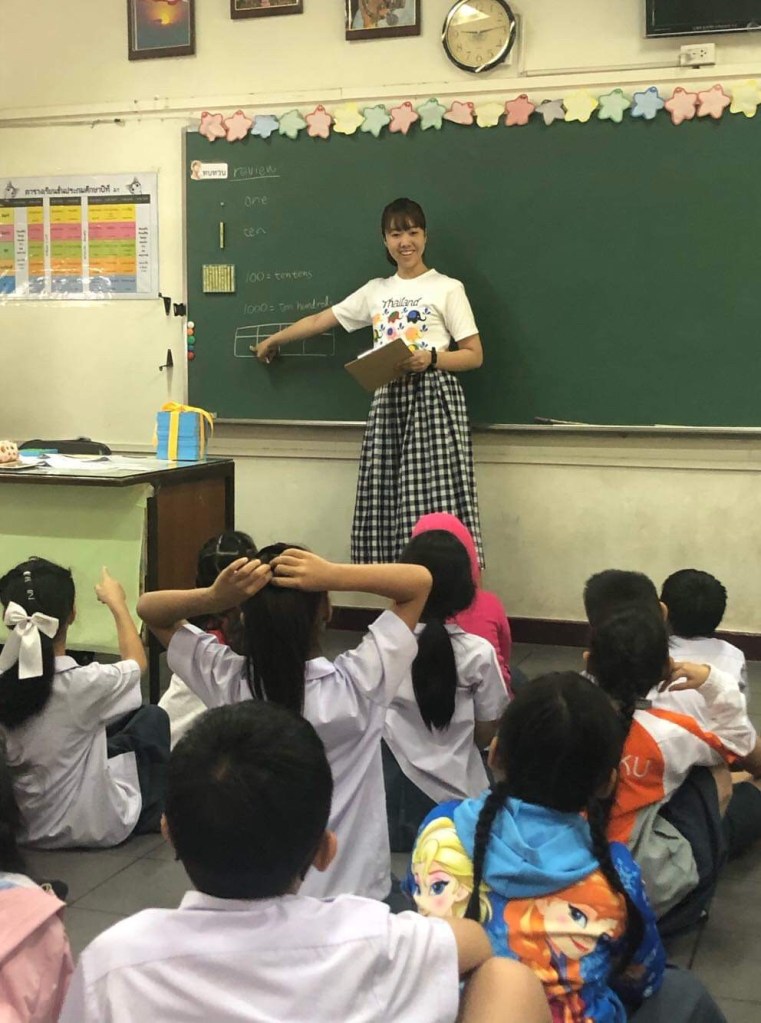
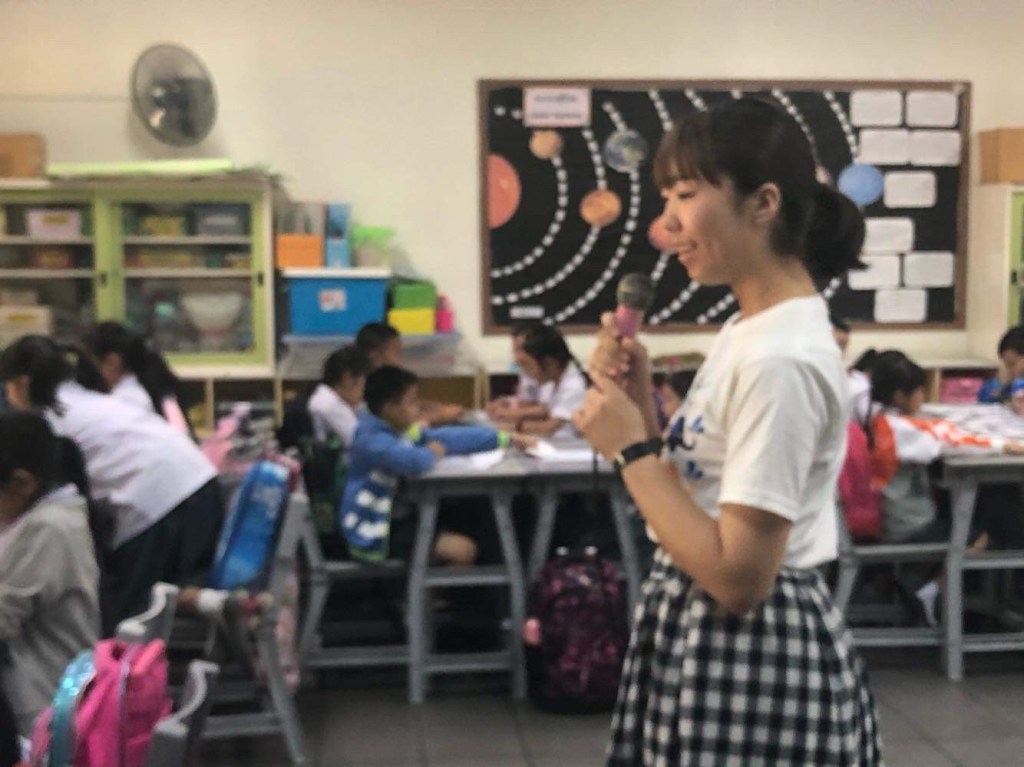
I also experienced actually teaching.  I had never taught at a Japanese elementary school, but I was able to finish the class.  What I was in charge of was a card game that made use of what students had learned in previous classes.  My English was translated by a trainee at Khon Kaen University, who was with my mentor, and the class was conducted.  I studied numbers and simple Thai and then went to class, but of course I couldn’t use it.  The students seemed to have enjoyed it, and the class was successful, but I felt the frustration that the words could not be conveyed by myself.  I wasn’t even able to say “be quiet” to the students who were excited about the game.  It was very frustrating.  When the teachers of Thailand departed from students’ attention, they sing in Thai language, “if you’re happy and you know it clap your hands,” and again attracted the attention of the students.  I could not do it.  I had a lot of thoughts, but I was very happy that the students listened to me straight and answered the questions well.  I have learned the difficulties of teaching students in different languages, but with some measure, it might be possible.  I think that being able to do this is a huge advance in the globalized world, so I felt that this might also be a very interesting subject to study at university.

There are many other events that left a lasting impression outside of math classes.

 For example, snack time.  Thai Elementary School has snack time twice a day.  The first is after the first period and the second is after the fifth period.  Both are time that students be hungry.  When I was in elementary school, I was often hungry and couldn’t concentrate on classes, so I thought this was a very good idea.

 The other thing is to always say sutra at the morning ceremony.  In Japan, public facility is unlikely to support a particular religion because of the separation of religion and politics.  In Thailand, Buddhism has been chosen as the state religion, so it may be natural to have sutras in elementary school, but it was a big shock to me.

 Even the slightest event, where a teacher and a student pass each other in a corridor, shows a difference from Japan.  In Thailand, it is customary to use both hands when giving thanks or greetings.  When they pass by students in the corridor, students usually put their belongings on the floor once and greet them with both hands firmly.  In Japan, it is no more than a bowing, but Thai children is very polite.

 Thus, I cannot talk about everything that I learned from this program.  It was a wonderful experience to stay in Thailand for a month and to interact with the students and teachers.  As I said before, I want to get a job related to education in the future, but I haven’t decided yet. I can’t claim I certainly become a teacher.  However, as long as you want to be involved in education, the results of this experience will become blood and flesh in the future.  Until I actually arrived in Thailand, it was my first time to stay abroad for a long time, and sometimes I was nervous and thought that I didn’t want to go.  But now I am really grateful to be brave and apply for this program.  Thai people are so kind and I am very lonely to leave here.  However, I want to use my experiences and feelings here to further expand my world.  I hope to come back someday and meet nostalgic people and report what I have learned after returning to Japan.

Religious education in Thailand

In this article, I will talk about religious education in Thailand.

In Japan, the separation of religion and policy that politician and government are banned for supporting a certain religion as a nation. But in Thailand the situation is quite different. In Thailand, Buddhism is a state religion, and education is provided for Buddhism even at normal schools.

I will introduce how religious education is conducted.

Morning ceremony
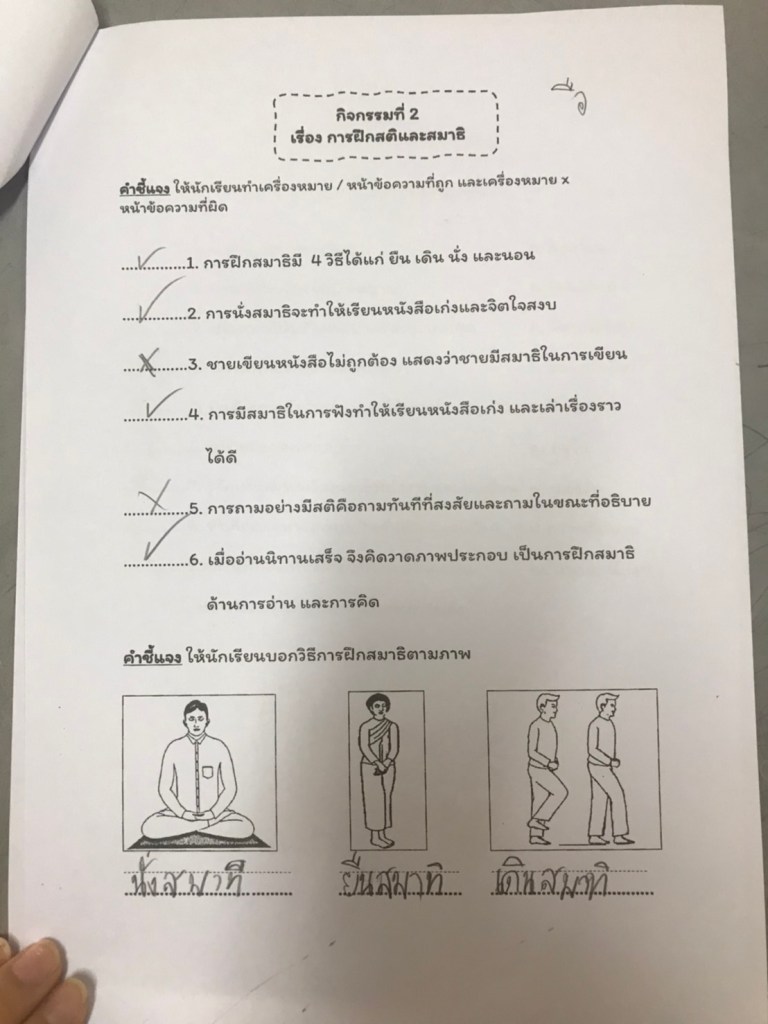
As I mentioned a little in the second article, the students pray to the Buddha at the morning ceremony each morning. Everyone faces in the same direction, join hands and chanting sutras. I heard from a student at Khon Kaen University that it is customary to recite sutras in every school.

Classes like SEIKATSUKA
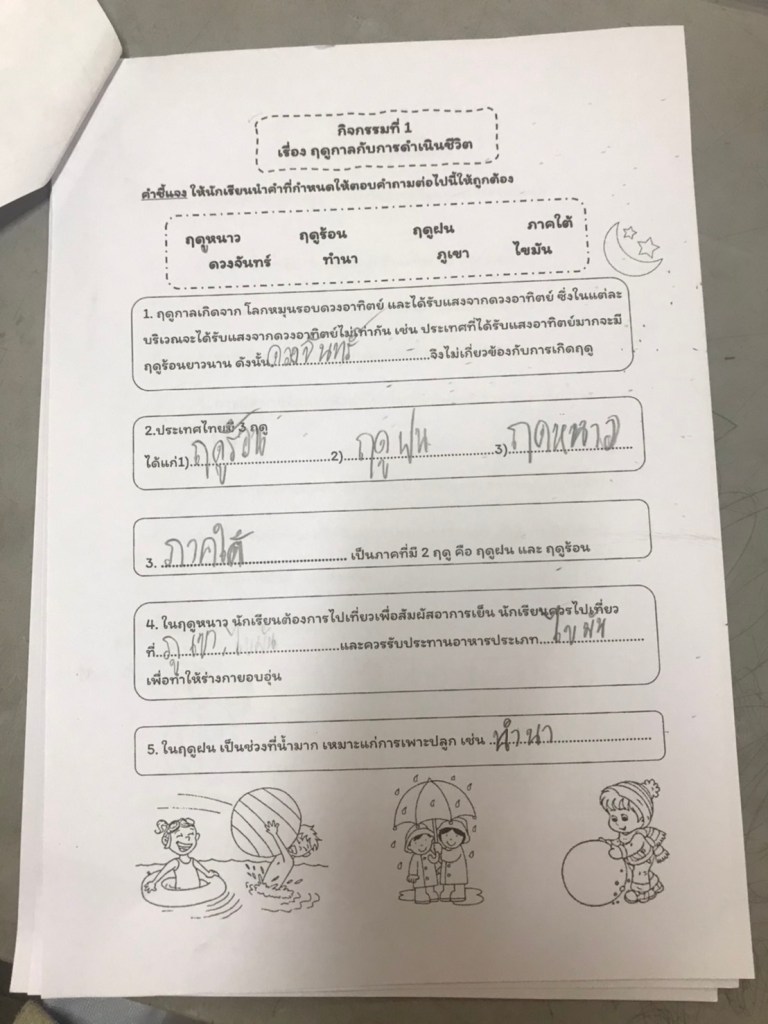
In the lower grades of elementary schools in Japan, there is a subject called “SEIKATSUKA”. This subject will later evolve into science and society. Aside from that, it seems that Thailand has classes to learn about Thai culture and seasons.

The image above is a print of the lesson, but of course it is written in Thai, so I will explain a little. The first is the cover. The second piece is about the Thai season. The third is mainly about meditation. The fourth is about other countries belonging to ASEAN. It is the third piece that should be noted. The third piece describes meditation, but it states that meditation calms the mind of students. Meditation may not be a very advanced religious act, but teaching this action at school makes me; be born in Japan that have policy of separation of policy and religion feel uncomfortable.

In this way, I introduced that Thailand, which has a state religion, actively conducts religious education. By the way, because national religion is Buddhism, it doesn’t seem to have to religion in Buddhism. But they cannot complain about the special treatment of Buddhism as a country.

Class system in this school

In this article, I will talk about the Thai elementary school class system.

My mentor; Aree is a second grade in charge and also second grade math teacher. Therefore, I have a lot of opportunities for communicating with second grade students.

In fact, there are four classes in each grade, class 1 and class 2 are English courses, and class 3 and class 4 are regular courses. When students enroll, parents decide the course. The difference between an English course and a regular course is not just the curriculum. There is a big difference in academic ability. For example, a task that students of class 1 finishes in one frame (approximately 45 minutes) cannot be completed by students of class 3 that they taking two frames. Not only the difference in scholastic ability, but also the attitude to participate in the class varies greatly. Teachers seem to pay more attention to the students when teaching class 3 than when teaching class 1 . Even in group activities, there are fewer students who can work seriously, and students who play and talk are conspicuous. So what makes this difference? According to mentor Aree, the financial situation of the parents has a big impact. Many of the students in the English course are born to a wealthy family, and receive higher quality education at private schools or so. On the other hand, in the regular course, about half of the students are said to be from poor families.
But apart from that, there is no difference between them, and the children live well regardless of class.
It is the same in Japan that the economic situation of the student’s family affects the student’s academic achievement. It may be very difficult to give every student the opportunity to study equally. That’s why I realized again that there was a need for an environment, educational materials and processes that all students could enjoy and learn.

My first class

This time I will talk about my first class.

The mentor teacher asked me which page of the textbook I would be in charge of, so I started preparation. I was in charge of a page that increased students’ understanding through card games.

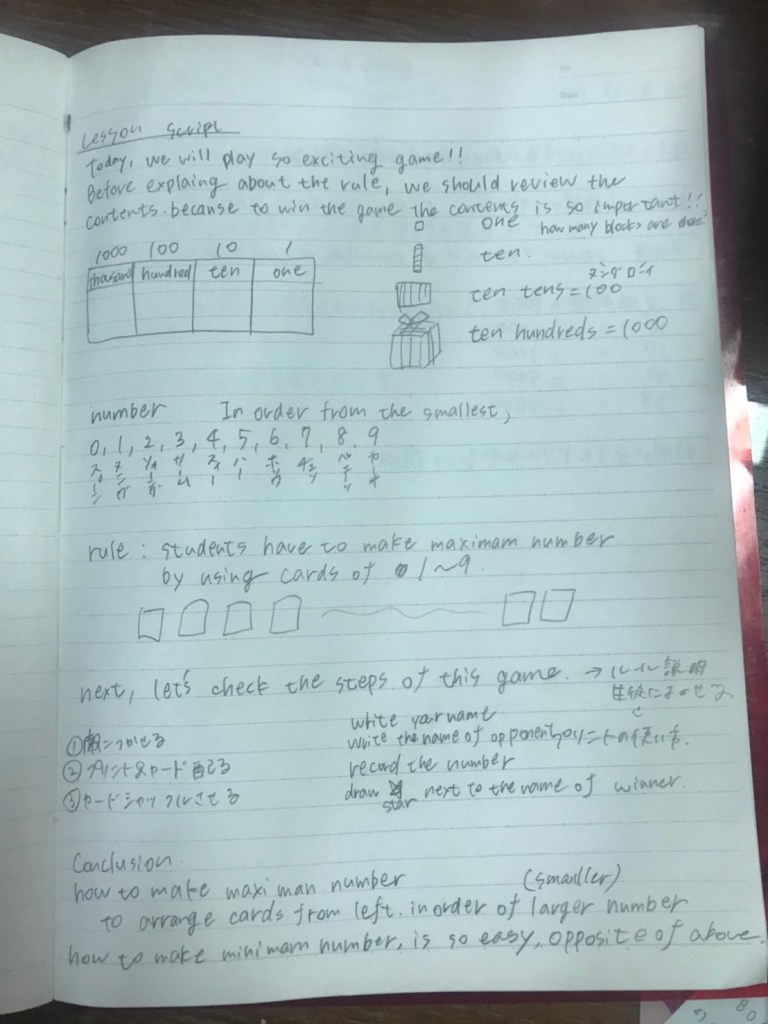
my lesson script( sorry for the crude)

One day after school, I had a meeting with the teachers. We checked the lesson flow according to the lesson plan you have created. The lesson flow is as follows.

review
I will review what they learned in the previous class

Rule description
Have the students read and understand the pre-written Thai rule descriptions.
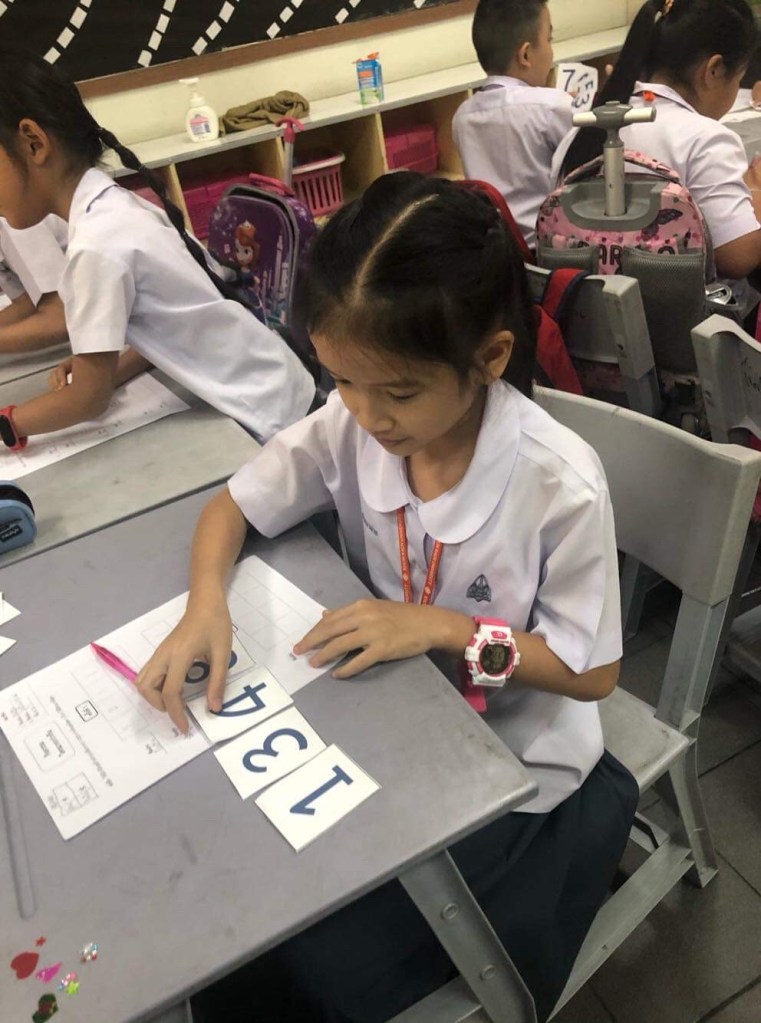
The game is played in pairs. There are two cards each with the numbers 1 to 9, and the one who randomly picks and arranges four cards from among them and makes larger number wins.

Game practice
Play the game according to the rules.
(Let’s get to the seat → Distribute the print and card → Shuffle the card → Write the name on the print → Make a rock-paper-scissor → Take the card in order from the student who won the rock-paper-scissor → Make a 4-digit number by arranging to determine the win and loss with the opponent and write the number on the print)

Conclusion
Find out how to arrange the cards to make a larger number with 4 cards. The answer may be a large number from left to right. When deciding on winning or losing, it is better to compare the number from the thousandth place and decide which one wins.
I draw the above ideas from the children and record them on the blackboard.

When I first taught at a Thai elementary school this time, I felt frustrated that language was not transmitted. No matter what I told the children, it was hard to get a translation. If I just teach, it may be enough to have an interpreter, but when it comes to games like this, the children will be excited and more energetic than usual. At that time, it was really sad that I couldn’t even say a word “be quiet” in my own words. I practiced using numbers and simple words in Thai, but I didn’t have much to do in class. However, the class was successful because the students were trying to understand my class and my teachers desperately translated. I want to make use of this valuable experience in the future.

Math class in Thailand

Today I would like to talk more about math classes.

First, in the first class of the day, students greet the teacher.
It ’s like “Sawadhika, Aja xxx”.
“Sawadhika” plays the whole of greeting in Thai. This one is very useful because it represents the meaning of “Hello”, “good morning”, “Good evening,” “goodbye”. “Aja” means teacher.
“Sawadeka, Aja SUZUKA” . The students greet all teachers with their hands facing and making eye contact with teacher. I ’m a little shy and I ’m holding hands and listening to the words.

As I mentioned in the other post, the students sit side by side on the floor instead of the desk and listen to the teacher.

Arithmetic classes are conducted in the following procedure.
Review → Input of new knowledge → Output through assignment → Summary

I will explain them one by one.

review
This is mainly done using the problems solved in the previous lesson. Although it is not limited to reviewing, the teacher does not evil everything on the blackboard, but proceeds with the students giving their opinions each time.

Input of new knowledge
This is the main process of class. Based on the examples, teachers teach students the process of “how to answer”.

Output through assignments
It is mainly a group activity using prints. Students are required to explain the process of thinking rather than just answer the question. They need to show their thoughts with text, pictures, figures and formulas. There are so many blanks that they have to fill in that they share the work and fill in the prints.

Conclusion
Particularly well-printed and well-thought-out groups will present their ideas in front of everyone. If they go ahead, first introduce themselves.
Finally, the teacher summarizes the lesson.

In general, I feel that it is the same as Japanese classes, but I am still not used to the fact that the students are on the floor. There are times when the morning ceremony is prolonged and the review is omitted, and sometimes it’s personal work instead of group work. It is very fun and interesting to observe physical elementary school classes.

Extra edition vol.1

Hello, it’s SUZUKA.

Today, I want to talk about my travel to Bangkok. Because of traditional public holiday of Thailand, our first weekend in Thailand was three consecutive holidays!! It is our first visit of Thailand and we wanted to visit as many places as we can during this short stay.

On the night of Saturday, we boarded on airplane and depart for Bangkok. The night view of Bangkok from airplane was so beautiful that we were fascinated by that.

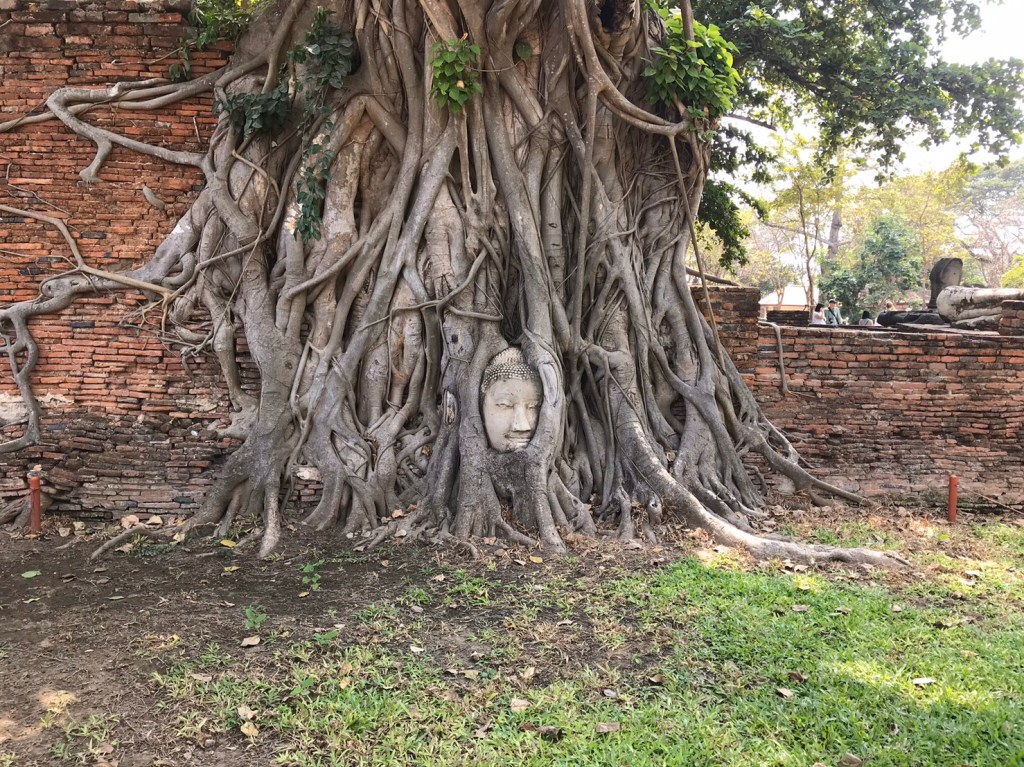
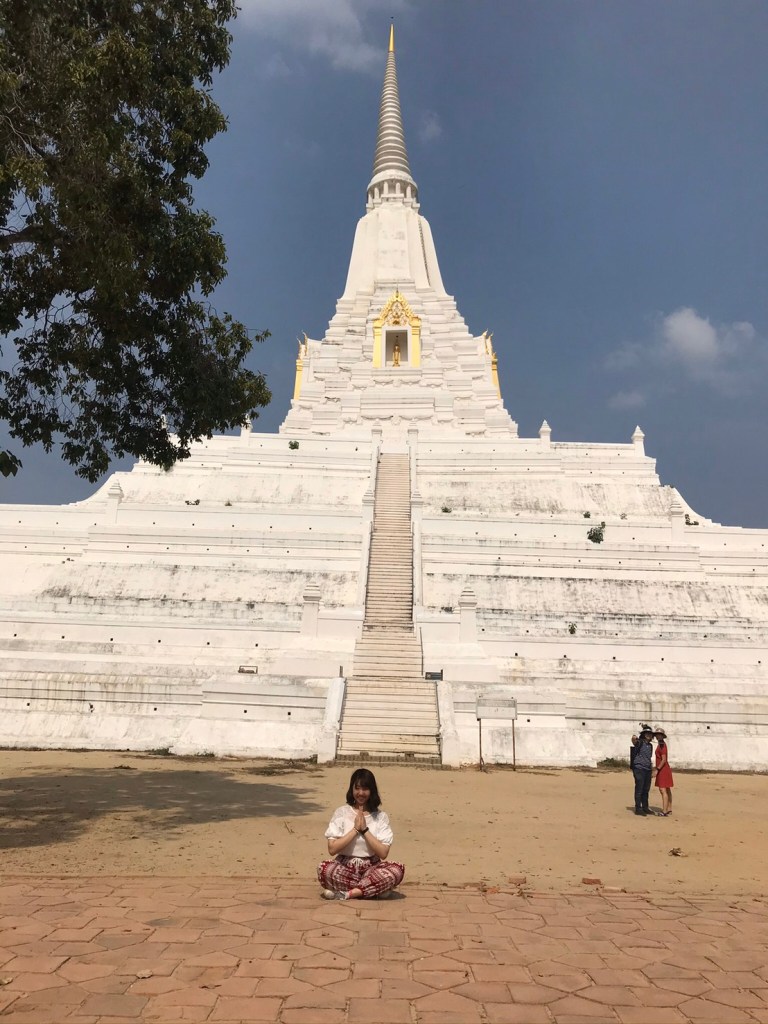
On Sunday morning, we departed from Bangkok to Ayutthaya to see our friend ; MAKI living in the city near Bangkok. Ayutthaya was fascinate place to see around that MAKI recommended us to visit there during the stay in Thailand.

All a saw there was so mysterious and majestic that my heart was washed. There are too much place for sightseeing that we couldn’t go to all of them. If it was possible I want to go there again. After going back to Ayutthaya station and rode on the train, we said good bye to MAKI and go back to Bangkok.

On Monday, we went around the city of Bangkok.

We went to wat pho and wat arun. The temple was so beautiful that I thought ” I can look this view forever”. We also went to train market that is really famous and popular in Japan.

Through this travel, I could touch the culture of Thailand. I can only stay here for 1 month but I ant to feel Thai culture and tradition to the fullest!!

First week has been over.

Hello. I’m SUZUKA.

After arriving at Khon Kaen city, before you could say Jack Robinson, passed one week!! I experienced so many things in multi perspectives.

In the school, I usually observed the class. There are many University Students who will be teacher next spring and help me so much. Also my mentor is so kind and well takes care of me. I’m in teacherroom for teachers of 2nd grade students and all of teachers are so kind too.

I will talk about the class of Thailand. There are so many differences compared to Japanese elementary school.

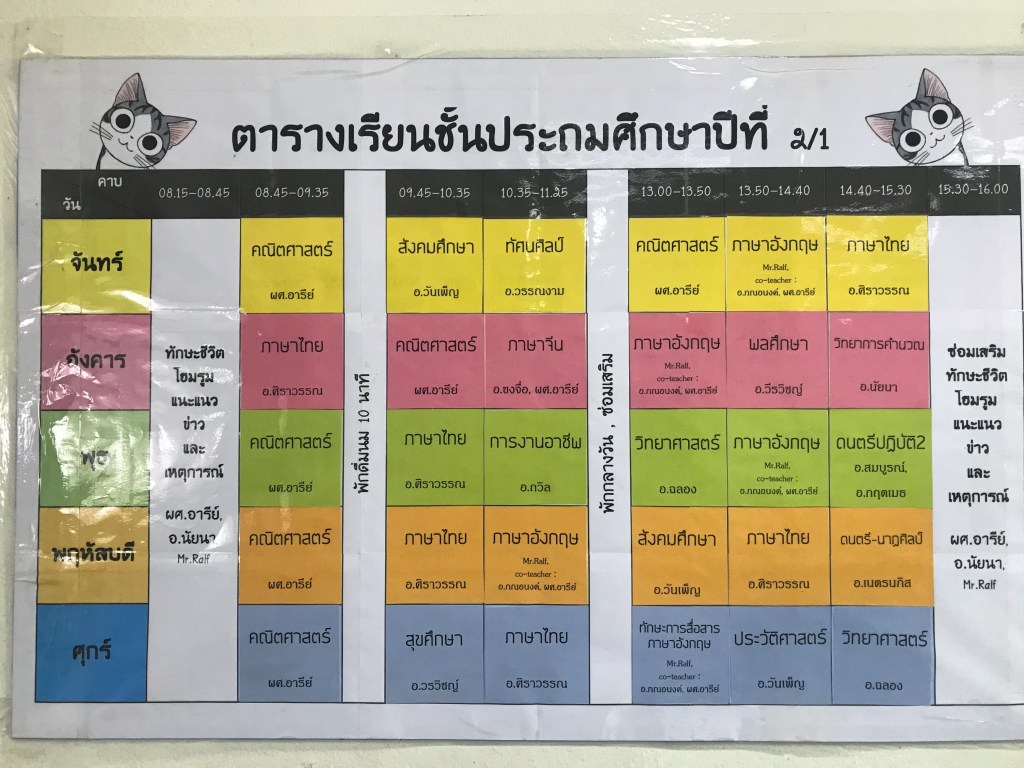
This is an example of schedule of students. They come to school around 8 a.m. and go to the square of the school and hold morning ceremony. All grades of student are gathered and do something like praying, the representative students read the script and the others repeat that. After that some teachers speak on the stage and the ceremony over. Sometimes the ceremony prolongs and consumes the time for first period.

After going back to each classroom, teachers start the class. As I said in the above, there are so many differences from Japanese school.

・Students take off the shoes before entering the room but teachers don’t. 

・In math class, students sit on the floor, not chair.

・While listen to teacher, students don’t take notebook.

・For each subject, there are teachers in charge.

These are the differences that I was really surprised at. Especially, the second one made me shocked. However, it maybe good way to make students near the black board and teacher, and make them more concentrate on the contents. Certainly, they actively speak up their ideas by themselves and it looks easy for teacher to pick up good idea that she should share hole the class members. It is same as Japan that lower grade students (about 1st grade to 3rd grade) cannot concentrate on the class. After a short time, their concentration are lost and they start to chat each other, fiddle with hand and so on. Then, teacher in Thailand says like, “crap your hands once! crap your hands twice!”. Students are so simple that try to keep up with the play. Teacher often sing a song ” If you’re happy and you know it, crap your hands”. By using these way, teachers easily gather student’s attention and smoothly conduct class.

The state of class of mathmatics

Anyway, like this, class is hold. Surprisingly, there are two times of time of snack in a day. One is after the first period and the other is before the homeroom. I think this is also good for students because if they are hungry they cannot concentrate on the class. Usually, they drink yogurt or milk and eat little donuts.

Classes last 50 minutes and there is basically no break between classes. Students often be late for the class because there is no break and time to prepare for next class. It is impossible in Japan but both teachers and students don’t worry about that.

After homeroom, students go to each activity. There are students who go back to their house, who play soccer as club activity and so on. In this school, it is natural that the parents pick their child up everyday. In the morning and afterschool, there are so many cars of parents. There are many differences from Japan in Thailand. It is really precious experience for me to think what is best for students.

Incidentally, I will talk about my everyday life in Thailand. Now, it is cool in Thailand compared to hottest season. My mentor; Miss Aree told me like this, ” there are 3 seasons in Thailand, hot, hotter and hottest!!”. I felt so interesting. Main transportation of university students in Khon Kaen is bike. We don’t have the one, so we ride on shuttle bus that is free and be managed by KKU to go school every morning. The sunshine of Thailand is so strong that my instep was clearly tanned in the shape of a sandal string. When we go shopping, the bus isn’t enough to go where we want to go that we sometimes use the system of ” Grab “. This system is so convenient for us. Soon after I book the grab car, it picks me up at where we designated and takes us where we want to go with cheap fee.

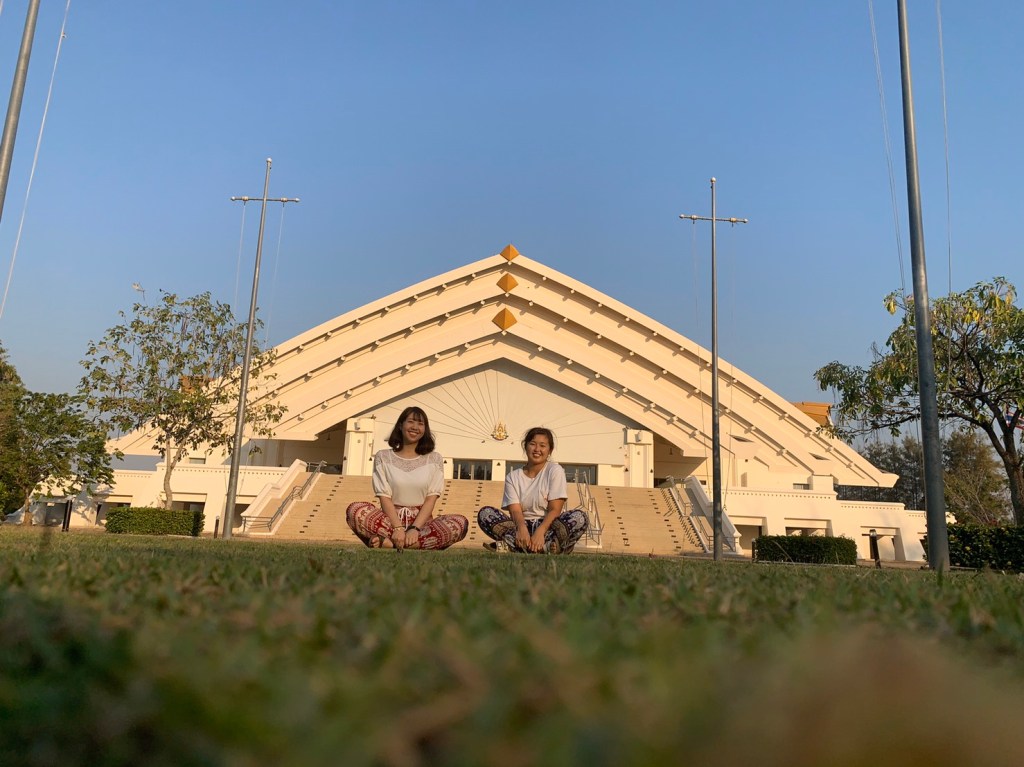
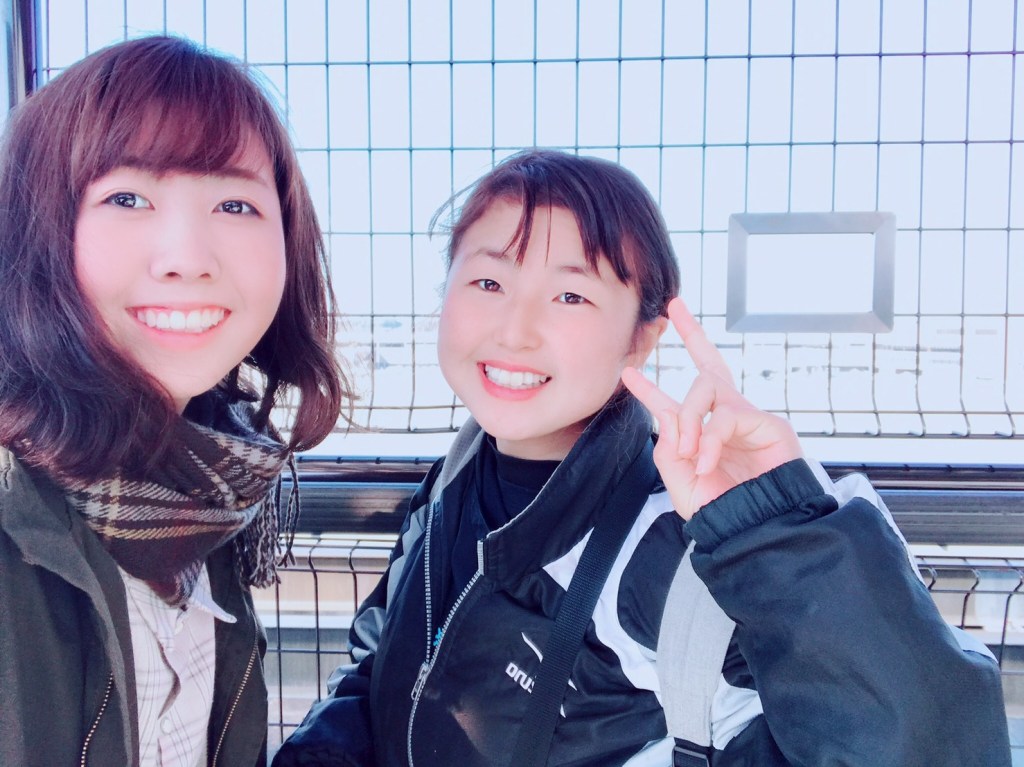
YOSHIKA and ME in front of famous building of KKU; Golden Jubilee Hall

Likely above, I can get used to the life in Thailand little by little.

See you next post….

HELLO

Before begining this blog I have to introduce by myself.

My name is SUZUKA. I am a 2nd grade student of University of TSUKUBA in Japan. I am in Thailand because of the wonderful program; sea-teacher. I will explain about this program.

Sea-teacher program is the program that exchanges “Education apprentice( in other words, students who will engage in education in the future)” between 4 coutries; Indonesia, Philippines, Thailand and Japan. Each country choose 6 students and dispatch 2 students to three other countries. Until last year, Japan hasn’t been a member of this program. Though from this year, be accepted by these Southeast Asian countries. Of course, it is the first challenge of TSUKUBA University so that there are no student who I can rely on and ask anything about this program. I was really anxious because it is my first time to reserve airplane by myself , to stay abroad for so long time, to visit country of southeast asia, to know about visa and so on.

I was dispatched to elementary school in Khon kaen city and will teach mathmatics to 2nd grade pupils. As I mention above, I was really anxious about everything. However, thanks to YOSHIKA who is dispatched from Japan to Thailand with me and all kind Thai people, I could managed to get to Khon Kaen city and start living in this exotic land happily.

I will spell the experience on this blog, thanks for reading.

nervous before boarding on airplane@Narita International Airport
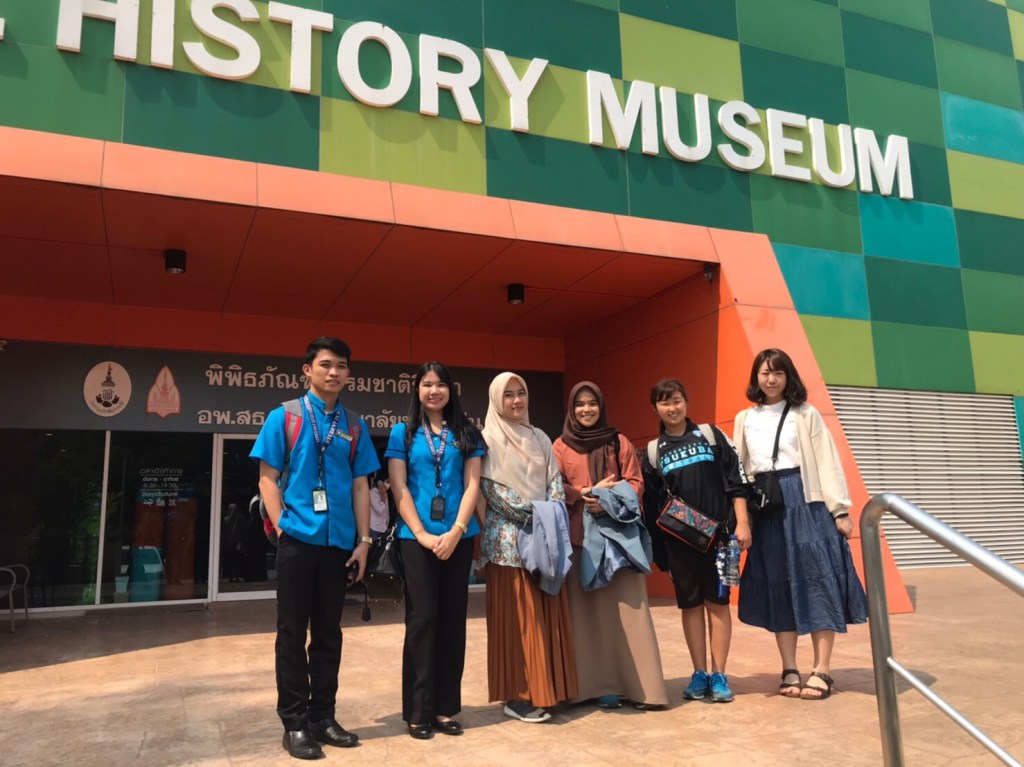
Visit faculty of Khon Kaen University with 5 friends.(from left, the students of Philippines, Indonesia and Japan)
With my sweet menter teacher; miss Aree.
WordPress.comで自分のサイトを無料で作成しましょう。自分のサイトを作成しましょう。
無料で開始